Cold email tools send to a list you bring. Dueted decides who is on it.
Outbound built on the asset you are selling. The portfolio is the root: a domain, the companies whose exact match .com it is, a named human at each one, and a rule that decides which of them a campaign is sending to. Then it sends on warmed mailboxes and brings the reply back.
The list you bring against the list Dueted builds
Who gets the email. A row in a CSV. Whatever was in the file the day you exported it: a name, an address, some columns. Nothing in it knows what you are selling, so nothing in it can tell you whether this company should hear from you at all.
A contact, under a company, under a domain you own. A research agent finds the companies whose exact match .com the domain is, scores them, cites its sources, and keeps the provenance of every run back to the lead it created. The contact carries its MX record and whether a person verified it. Unverified stays visibly unverified; it is never quietly promoted to fact.
Who stays on the list. A frozen import. Research that lands on Tuesday is not in Monday’s file, so you export again, import again, and hope the deduplication held. Take someone out and the next import puts them back.
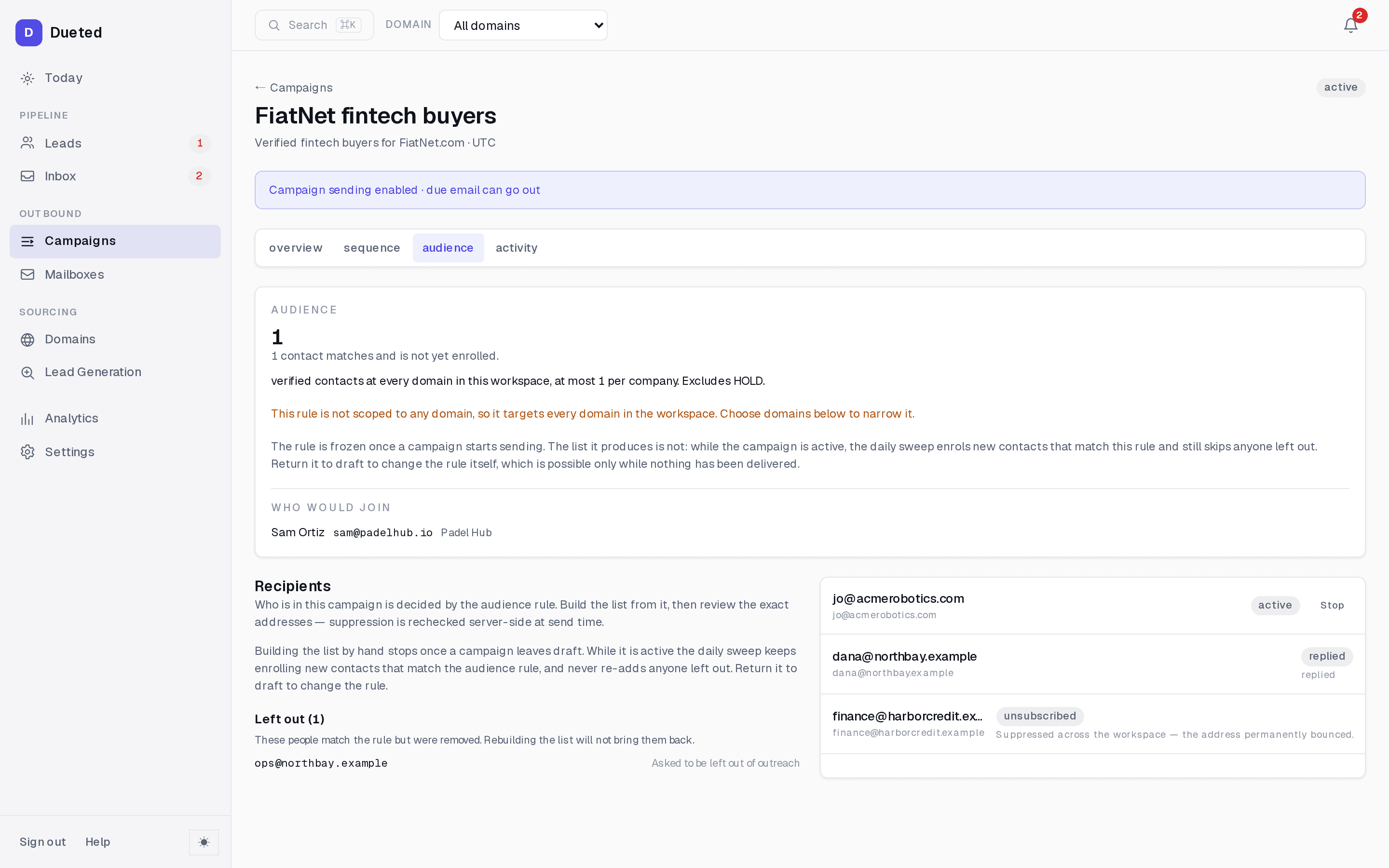
An audience rule. Membership is computed from the rule, never stored as a roster: scope it to one domain or leave it across the whole portfolio, cap it per company, require a verified contact, exclude anything on legal hold. While the campaign is active a daily sweep enrols new contacts that match, with no re-import. Remove someone and it writes an exclusion, so rebuilding the list never brings them back.
Who signed off. Send and hope. The sequence is in one place, the list is in another, and the thing that actually goes out is neither of them.
The rule and the sequence are both on screen before you approve, and the approval covers the rule rather than a snapshot of names, so the list can keep growing and the approval still means something. Nothing enrols against a rule whose approval is no longer current. Once a campaign has mailed someone, it cannot be edited.
This is where the comparison runs out. Sequencing, mailbox rotation and warmup are table stakes: Instantly, Smartlead and Lemlist have them, and so does Dueted. They are not the claim. What follows is the rest of the loop, from the mailbox that carries the send to the deal that closes it.
Sending is infrastructure you watch, not a setting you filled in once.
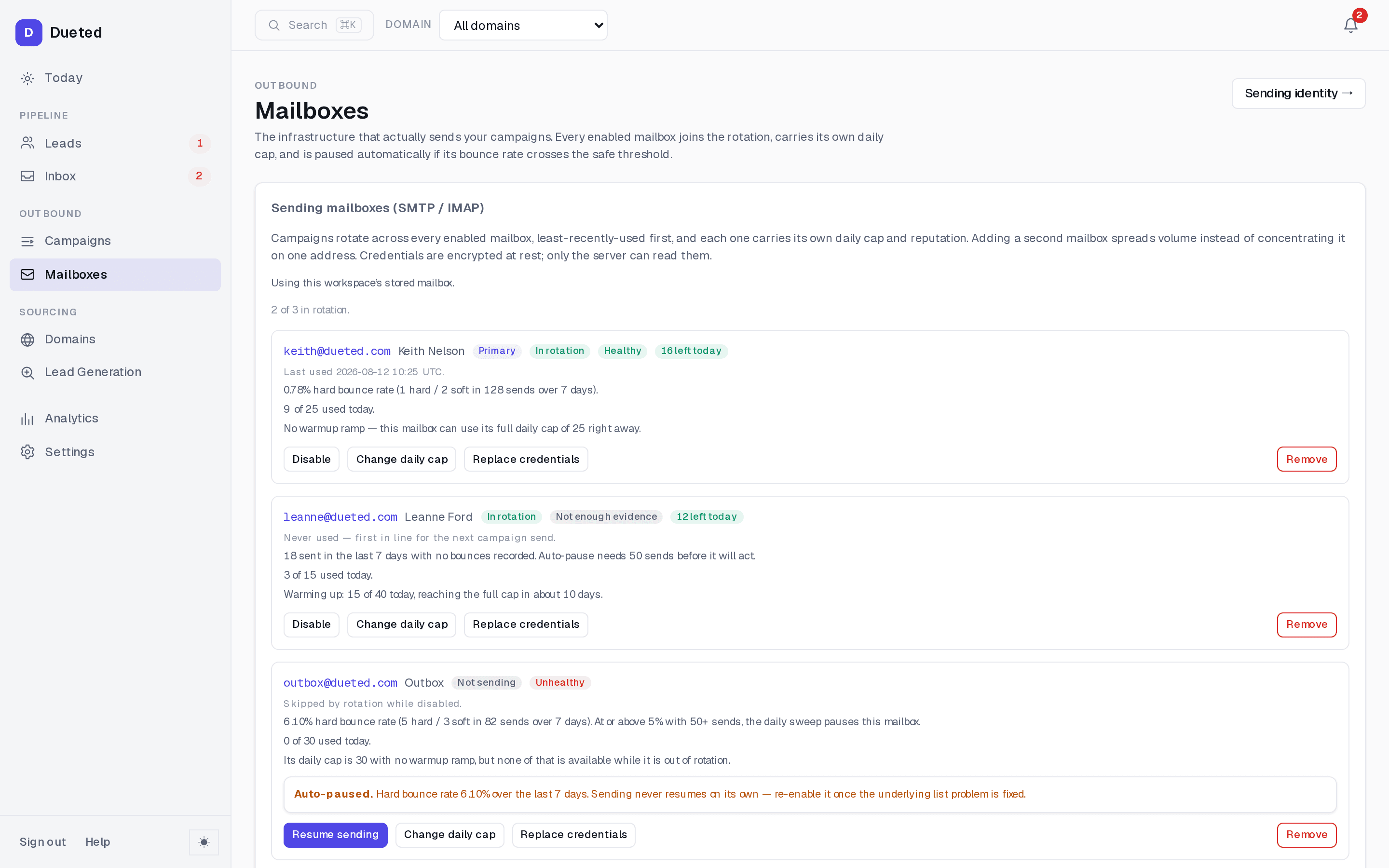
Mailboxes are their own area in the product, not a card in settings. Campaigns rotate across every enabled mailbox, least recently used first, and each one carries its own daily cap, its own warmup ramp and its own bounce history. Adding a second mailbox spreads volume instead of concentrating it on one address.
- Sending window
- Nothing leaves outside the days and hours the campaign allows.
- Pacing gap
- A minimum gap between two sends, so a batch does not arrive looking like a batch.
- Mailbox daily cap
- Per mailbox, and lower than the cap while that mailbox is still warming up.
- Workspace daily cap
- A ceiling across every mailbox in the workspace, not just the busiest one.
- Suppression list
- Rechecked server side at send time, not at the moment the list was built.
Every one of those gates defers rather than fails, because a deferral clears and a dead letter does not. And once SMTP accepts, nothing is ever re-sent: an outcome that is not clearly a success or a failure is flagged for a person to look at, never retried. A duplicate email to a prospect is worse than a missing audit row.
When a send does get stranded, it is listed on the campaign itself and requeued in one click, and the requeue refuses where the message may already have gone out rather than risking a second copy. That path exists because it was needed once, and doing it by hand is not a feature.
A follow-up lands in the same conversation, not as a second cold email.
A sequence is a first email plus follow-ups. A threaded follow-up carries no subject of its own: it inherits the subject of the thread it belongs to and goes out with the headers that reference the message it answers, so the recipient sees one conversation. A campaign can also stop the rest of a sequence the moment someone replies.
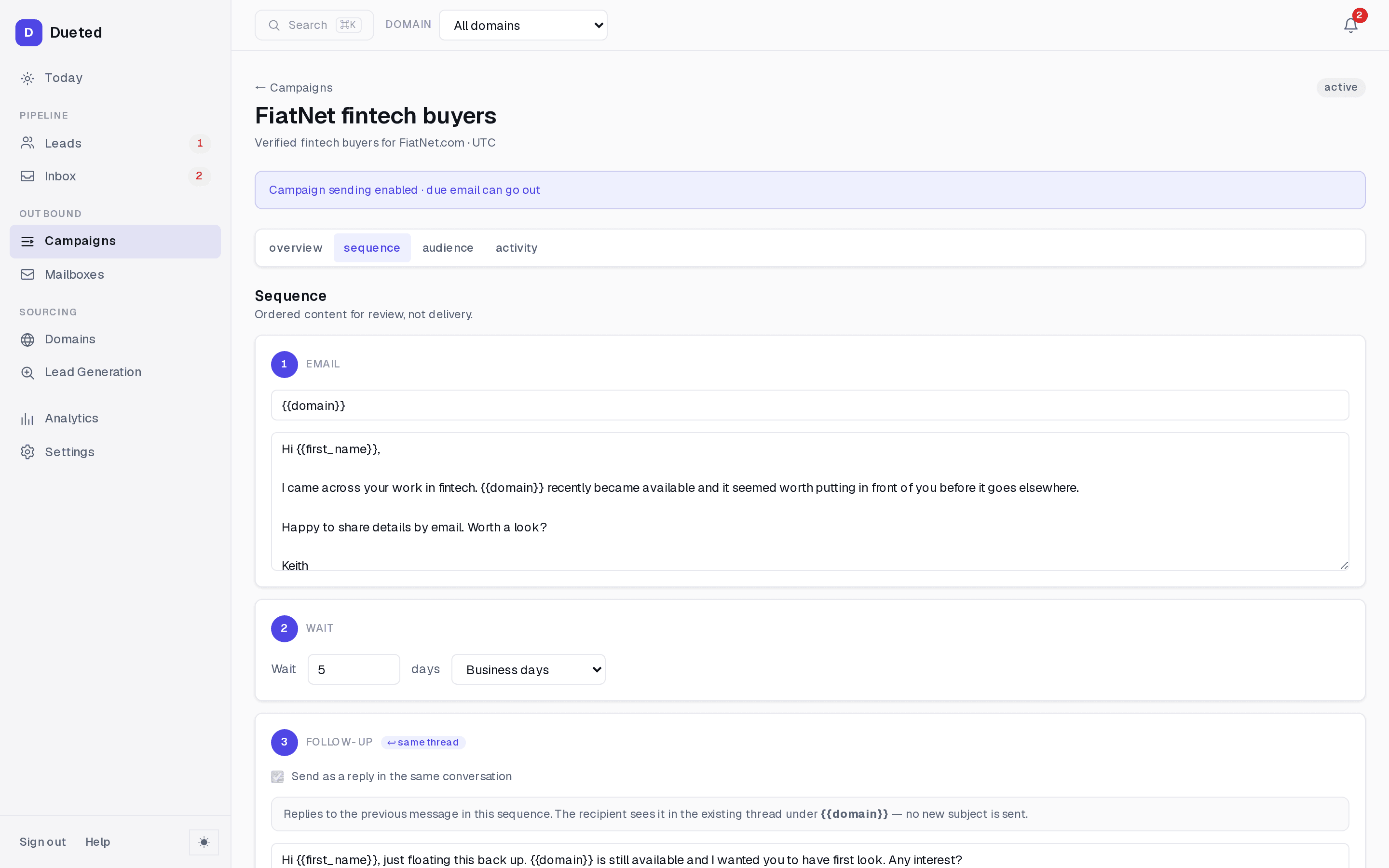
Verified end to end against real mailboxes on 9 August 2026: four recipients, two steps each, exactly one attempt and one send per recipient and step, every follow-up threaded onto its parent, and all four enrolments finished.
The reply comes back into the product, threaded and attributed.
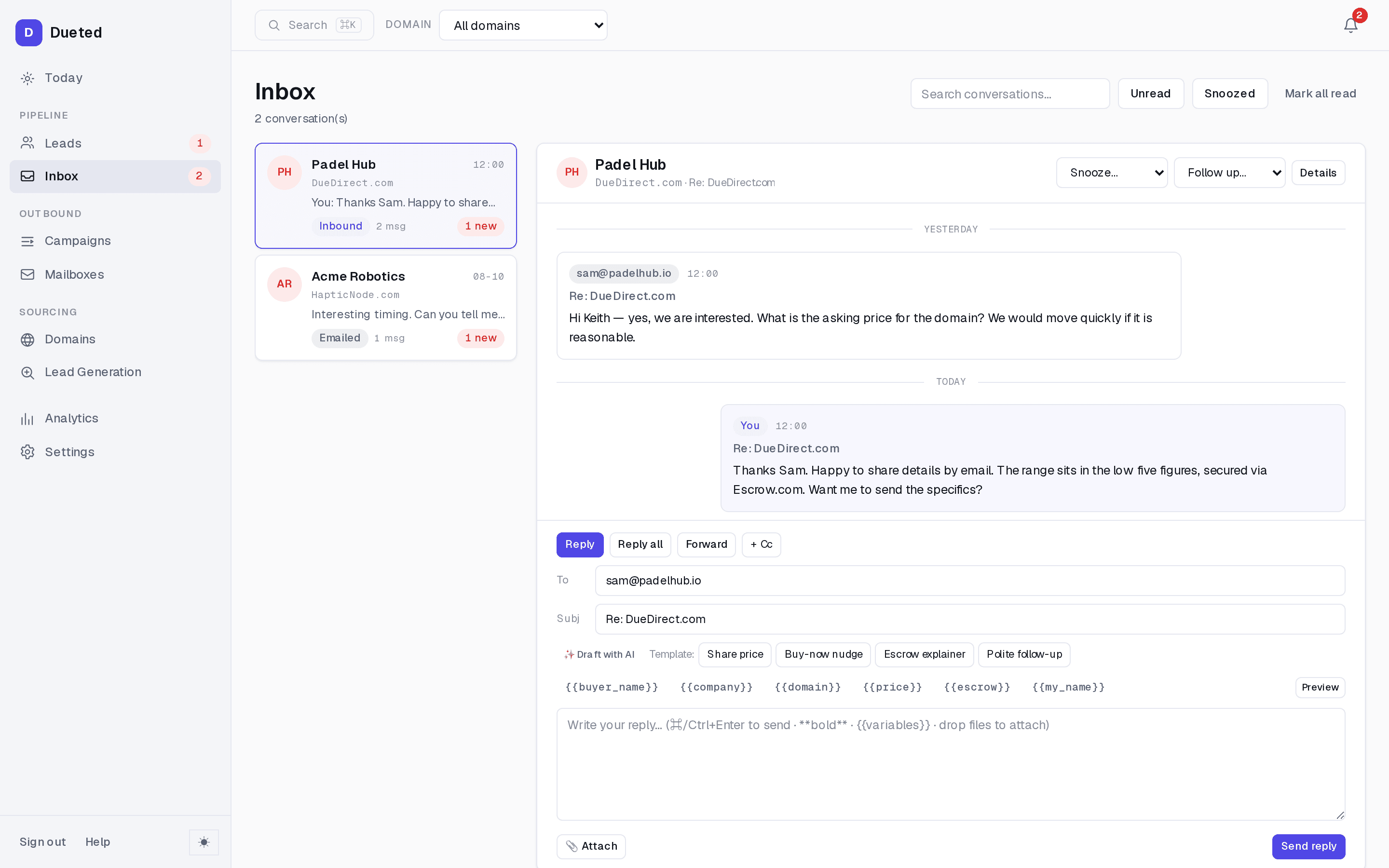
A mailbox sweep matches incoming mail to the message it answers, stamps the reply onto that send, and attributes it to the campaign that earned it. The conversation opens beside the lead it belongs to, with snooze, follow-up reminders, attachments, and internal notes that stay inside the team.
The deal, and the numbers that decide the next one.
Every lead carries an ask price, any offer received, and a walk-away floor, because a broker without money on the screen is running a mailing list. Above them sit the numbers that are actually decisions: the contacted to replied to won funnel with the ask still open, reply rate per template and variant, a pipeline health score, and the visit to form to submit funnel of each domain’s own for-sale page.
Inbound arrives in the same pipeline. Someone who fills in the form on a for-sale lander becomes a lead against that domain, in the same inbox as the outbound.
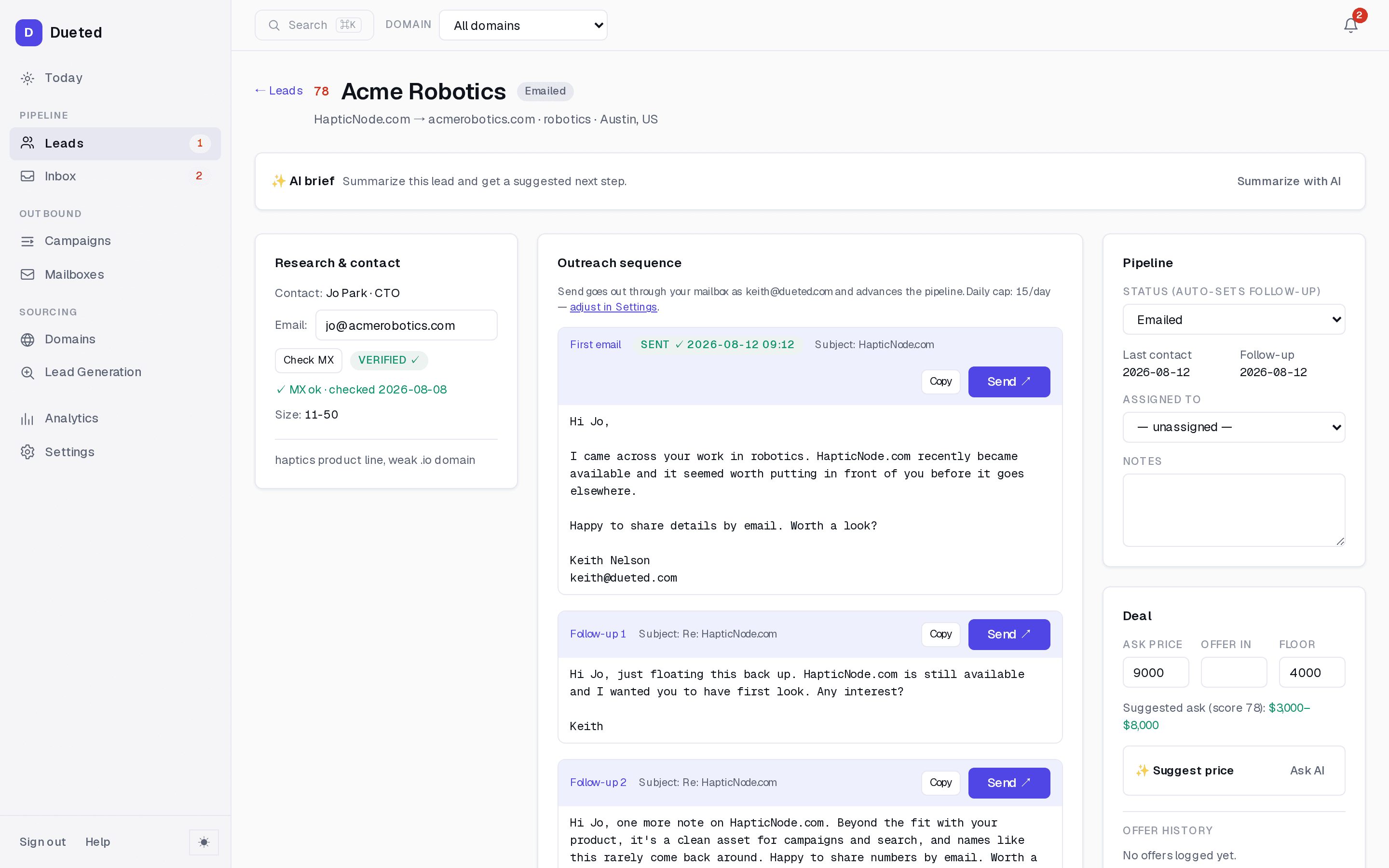
The evidence behind this page.
Dueted runs its author’s own portfolio. Six domains and more than sixty researched leads, live in production, with the storefront and every for-sale page served from the same database as the CRM. It was built by someone selling domains with it, not for a market studied from the outside.
Every screenshot here is the running application, captured from it by the project’s own test harness at 1440 by 900. The interface is real and current; the records inside it are the harness’s fixtures on the same portfolio domains. So there is nothing on this page that was drawn to look like software, and nothing on it that exposes a real buyer’s address.
There is also no customer count, no revenue figure and no aggregate reply rate on this page, because none of those exist yet. Dueted is in beta and says so.
Connections, named by the mechanism that carries them.
- Slack and Discord
- Workspace notifications over HMAC signed webhooks, formatted properly for each: Block Kit blocks for Slack, embeds for Discord.
- Any IMAP and SMTP mailbox
- Your own sending address, not a shared pool. Credentials are encrypted per workspace and only the server can read them.
- REST API v1
- Leads, domains, messages and conversations, behind scoped keys that are stored hashed. Zapier and Make connect through this plus a generic signed webhook, rather than a dedicated app.
- Escrow.com
- Named as the escrow provider in your settings and used by the reply templates that explain the transfer. It is a field and a template, not an API integration, and it is described that way here on purpose.
Bring your names and your mailbox.
Import your domains, add the buyers you have researched, connect a mailbox, and write the rule that decides who hears from you.